
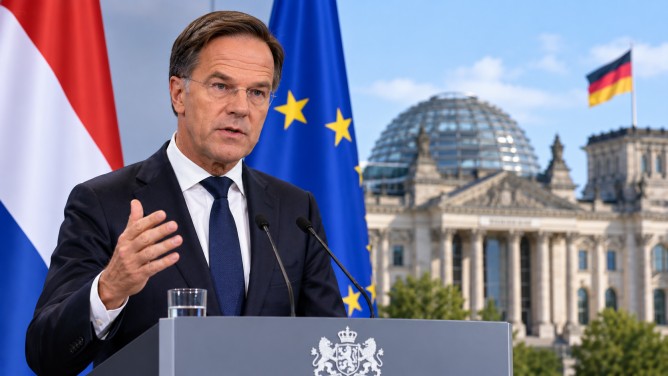
The recent electoral performance of the far-right Alternative for Germany (AfD) in Saxony-Anhalt has raised alarms across Europe, with Dutch Prime Minister Rob Jetten calling it a “wake-up call” for German politics. The AfD captured 43.8 percent of the vote, nearly securing an outright majority, while the Christian Democratic Union (CDU) came in a distant second with 17.2 percent. The Social Democratic Party (SPD), the Greens, and Die Linke trailed further behind with 9.3, 8.9, and 8.6 percent, respectively. Meanwhile, the BSW party managed to enter the state parliament with 5.3 percent of the vote.
Jetten acknowledged the democratic right of voters to choose their representatives but voiced concerns over AfD’s extreme positions and its perceived alignment with pro-Russian narratives. He urged German political leaders to delve into the reasons behind AfD’s growing support and to address the underlying issues troubling voters. This sentiment is echoed by officials in France and Poland, who see the election outcome as a sign of the increasing challenge posed by far-right movements across Europe, while Hungary’s former prime minister Viktor Orbán welcomed the result and extended congratulations to the AfD.
The AfD’s rise has stirred apprehension among German officials about potential threats to democratic values and the growing sway of Russian narratives. Reports of misinformation and foreign interference during the election campaign have further fueled the discourse on the factors contributing to the party’s popularity. Despite its significant gains, the AfD lacks the necessary seats to govern independently, and with many parties unwilling to collaborate due to its controversial stances on issues like migration, the formation of a stable state government remains uncertain.
AfD co-leader Alice Weidel has expressed the party’s ambition to expand its influence nationally, setting a goal of capturing at least 40 percent of the vote in the next federal election. However, the party’s future success hinges on its ability to overcome the political isolation imposed by its uncompromising positions. The election results in Saxony-Anhalt have intensified discussions across Germany and Europe concerning the rise of the far-right, voter dissatisfaction, and the evolving landscape of German politics.