
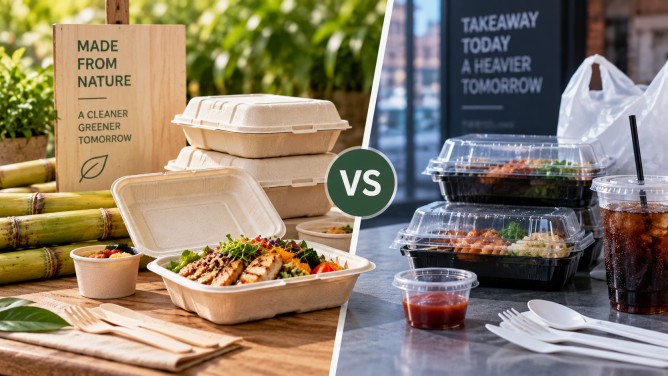
Choosing between bagasse and plastic food containers hinges on various factors such as the type of menu, holding time, sealing needs, regulatory requirements, end-of-life disposal options, and overall packaging costs. Bagasse is often ideal for hot dishes, rice meals, pasta, catering trays, and meals with compartments. Its molded-fiber structure offers durability and an appealing presentation, with additional barrier options enhancing its resistance to grease, moisture, and heat. For those focused on compostability, bagasse can be a viable option, though it’s crucial to assess the entire product system, including coatings, inks, and lids, along with the availability of composting facilities in the target market.
Plastic containers, on the other hand, are practical for chilled foods, items that require visibility, high-moisture applications, and cost-sensitive programs supported by local waste systems. It’s important for buyers to compare specific plastic products with potential bagasse alternatives. For many businesses, a gradual transition might be more feasible than an immediate overhaul of all plastic containers. The choice of container should align with the food’s characteristics—testing for deformation, leakage, and lid fit is essential for hot, oily, or sauce-laden meals. For fried foods, evaluating condensation and ventilation is crucial, while soups and liquid-heavy dishes require testing of the full container-and-lid system. Products intended for microwaving or reheating should be validated for those specific conditions.
There are distinctions among standard, coated, and laminated bagasse products. Coated and laminated bagasse offers enhanced resistance to oil and moisture, along with improved sealing and temperature performance. Laminated versions may include materials like PLA, PET, CPET, or EVOH, impacting their compostability or recyclability compared to unlaminated options. Evaluating total packaging costs involves more than just comparing purchase prices. Procurement teams should consider factors like carton quantities, freight efficiency, storage needs, lid compatibility, and disposal costs, among others. Conducting a controlled pilot with high-volume menu items can provide a clearer commercial picture before scaling up the use of bagasse products.
Shenzhen Grizzlies Industries Co., Ltd. supports businesses in transitioning to molded-fiber packaging with its OEM/ODM manufacturing capabilities. Their network, comprising 11 production bases and over 280 automated machines, offers a capacity of up to 200 × 40HQ containers monthly. Grizzlies provides various bagasse products including plates, bowls, trays, clamshells, and food containers, with customization options for molds, compartment layouts, embossing, and more. Businesses can submit their current container specifications and needs to Grizzlies for sample evaluations and factory-direct quotations.
Ultimately, the decision between bagasse and plastic should be based on the specific advantages offered by each material for the intended food application and market. Bagasse offers benefits in rigidity and compostability, whereas plastic provides transparency and specialized sealing at a lower cost. Real-world testing with actual food items is critical before making a large-scale packaging transition.
Legal Disclaimer:
The information contained in this article has been provided by independent third-party contributors, clients, or content partners. We do not independently verify the accuracy, completeness, legality, ownership, licensing, or reliability of submitted content, including text, images, videos, trademarks, or other media materials. The submitting party is solely responsible for ensuring that all content, including images and media assets, complies with applicable copyright, trademark, licensing, and intellectual property laws. We disclaim liability for any unauthorized use of copyrighted or proprietary materials by third parties. If you believe that any content published on this platform infringes your intellectual property rights, kindly contact the author above for prompt review and resolution.